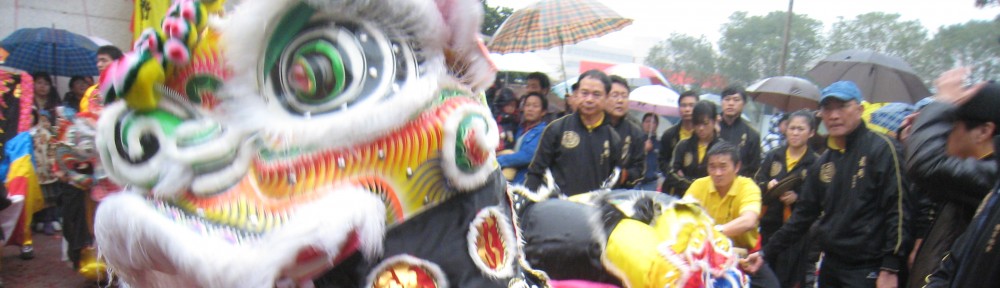
Who am I?
Ever since I was a small child I have loved the Chinese lion dance. I grew up in Cabramatta, the small but densely populated Chinese Vietnamese community of Sydney Australia. I was always surrounded by the Chinese lion dance. I remember during my childhood every Chinese New Year I would run out onto the streets and watch with great excitement as each kung fu school would proudly parade their dancing lions around the town from shop to shop, the lions gobbling up the hanging lettuce heads from above each shop door and the firecrackers blasting to leave a ground covered in red confetti and the air filled with gun powder smoke. During class I would sometimes hear the firecrackers blast off in the distance and I would long to leave class. On weekends I would delightedly make my way to the shops where rows of colourful kung fu school flags would line the street. My ears were trained to recognise the sound and rhythm of the lion dance drum and my eyes were concentrated on spotting a gathering crowd in the distance. There was something about those drums and the way those beautiful lions danced amongst the flashing firecrackers that drew me to watch the spectacle year after year.
During my teenage ears I finally mustered up the courage to join one of the top kung fu and lion dance schools in Cabramatta. Unfortunately my sifu shortly retired and the school closed. During that short time I was able to start my education about the Chinese lion dance and learn some dancing. I quickly learned the drums as I was so accustomed to the drum rhythm from my many years of watching and listening.
It was not until I further pursued my kung fu in Hong Kong that I really learned about the art and its intricacies. The seniors in Hong Kong practised the traditional Fut San style of lion dance and were a treasure of knowledge. They also introduced me to the unicorn dance native to the Hakka people, another art which I have developed a keen interest for.
Throughout the years, I’ve seen lion dancing change dramatically in my area from the lions itself, both number of lions used and how they look, to the schools dancing them, to the way firecrackers are cleaned up etc etc. And…. It just doesn’t bring back the same memories or as much excitement to me as it did when I am a kid and that’s not from lost interest in the art.
I will admit, I’m a traditionalist when it comes to lion dancing as part of a kung fu school and I have long yearned for the old days to return. Streets lined with flags of the various kung fu schools, fierce looking futsan lions danced properly by the seniors rather than 10 lions who bob up and down not knowing wat to do.
And my desire to make my own lion head? It first started about 5 years ago when my kung fu senior enlisted my help in restoring one of our old lion heads. That experience gave me some of the skills I needed in making a lion head from scratch.
I thought it would be a cool project to do and since I love lion dancing, and love seeing old lions, I thought I’d try my hand at making my own old school lion.
Thanks to the build and repair section of Liondancing.org/forum, I have been able to learn a lot about restoring lion heads and little bits of useful information of fixing and making certain parts of the lion. Armed with this knowledge and one of the school lion heads as a model, all I needed to do now was to get the materials and get stuck into it.
 wakeuplion
Hey, I know a guy from hongkong who sells lion heads. He also has bristle fur. If you want I can give you his email. Just email me at azndragonfan@yahoo.com
my friend I congratulate you on your project in the lions I wonder what city you are and I would like to meet you in person I’m glad to hear from you and your passion for this art I hope your answer thanks.
Thank you for your kind words. I’m sure there are many more passionate and talented people out there, I’m just lucky to share mine with this blog.
PS. I’m based out in Sydney, Australia
Date: Tue, 16 Apr 2013 13:52:32 +0000 To: nam_kuen@hotmail.com
Hi
I belong to a Choy Lee Fut Kung Fu school in Valdivia, Chile. A bit over a month ago our Kwoon suffered a devastating fire that destroyed everything, lion heads included. One of them was reduced to ashes, the other one was pretty damaged, with only half of the frame left and all the fur and most of the paper gone. I’m pretty new to Kung Fu and not a dancer myself, but since I consider myself quite good at handcrafts I decide to honor my Sifus by restoring (or rather building again) what was left of the Lion Head, probably the loss they still suffer the most.
I completed the bamboo frame and now I’m starting with the paper, but the more I advance, more questions I have because, to be honest, I’ve never seen other Heads beside the ones my school owned. I’m specially concerned with the moment I start painting and adding details because there is a lot I miss in pictures from the Internet, but specially because don’t know the meaning and traditions of the different parts and marks and I want it to be as true as traditions as possible.
If you could help me and guide me on my venture, I would really appreciate it.
Thanks
Please contact me at catuvalencia@yahoo.com
Hey mate, great blog and fantastic effort building lion from scratch. Just a question, when you and your wife used dulux paint, did you have to do a second coat? I just restored one of my old lions and used craft paint and found that I had to do a second layer to get a nice tone. Cheers, Richard
Hi, Im currently doing a restoration project as well. used your tip with the netting and about to begin with calligraphy paper. Have a question on the paste and which recipe did you use. and where did you purchase the white furs? any help is appreciated loved your dedication to the completion of the lions!
Eric
Hey Eric, the recipe for my paste is simple. I use plain flour mixed with water. I don’t cook it as I find that this takes too much time. I tried keeping the glue once over a few days but it turned sour so now I only make enough glue for each papering session . Make sure you sift the flour so there are no lumps. The consistency should ve a little bit more runny than pancake batter but you can work with different consistencies to see which works better for yourself. A trick with papering is layering two sheets of paper on each other. The glue mixture should soak through the second layer.
I’ve also changed when I stick the netting on. My original two lions I hot glued the netting directly onto the frame. It helps a lot with the paper sticking on. However, for the next 2 lions, I decided to try sandwich the netting in between the first and second layer of paper and that has worked well.
Total layer of paper I used is 3 and for the parts that are a little more easier to break (around the mouth, along the back where the ear holes are), I’ve added a fourth layer.
As for the fur- the rabbit fur for the parts like the nose and the fins, I bought a pelt of rabbit fur on ebay.
Hope the papering part goes well. You’ll feel a million bucks when you’re done. And please send pictures of your progress. It would be cool to see. Let me know how you go.
Supplier of Chinese Lion Dance equipment in Foshan, China
WeChat : Amy1506935648
Hi
I’m Garrett, based in Sydney. I spoke to Chris from restore the roar and he sent me you contact to chat more. What’s the best form of contact for you ?
Garrett
Hi Garrett,
My email is invincentble@hotmail.com. We could start with that.
Cheers,
Vincent
Hey, I’m not sure if you’re still active on this website but I really like your lion dance books section. Do you know how I can obtain them?
hungleuci@gmail.com
Hey, happy new year. Super late reply, but all the books that I bought were a little tricky to come by. A few I found on my trips to Hong Kong just browsing through the book section. I think there was one that I messaged someone through Facebook a number of years ago. That was a Singaporean book and another I somehow navigated a Taiwanese website to find it
Hello Wakeuplion,(Sorry if I don’t remember your name correctly.) I’ve always admired your work — it’s one of the few on the internet that explains and shows everything so clearly, and from my perspective, it has aged very well.Some time ago, I asked you about the mixture you used for the paper and gauze layers. Now I need help with the eye mechanism.Currently, I’m not in contact with my dance group, so I don’t have references from the team. I do have photos of the lions, and their eye system seems to use pulleys and strings, but mine uses levers and string — very different from what I’ve seen.I hope you can share some advice on how I can build it, and if you’ve uploaded a blog post or guide about this and I missed it, it would really help my progress.Wishing you a good day, and I hope I’m not bothering you. 🐍♥️